

EOFY is nearly here and if you are like most business owners, it creeps up faster than expected - especially when you are busy running the business instead of the admin.
There is tax to think about, payroll changes from 1 April 2026 and a pile of small admin jobs that suddenly feel urgent.
Let’s cut through the chaos.
EOFY doesn’t have to be overwhelming when your systems are clear and your numbers make sense.
Here is your straight-talking EOFY 2026 checklist for New Zealand business owners, including the key payroll and KiwiSaver changes to update before your first April pay run.
Grab a coffee and let’s walk through it together.
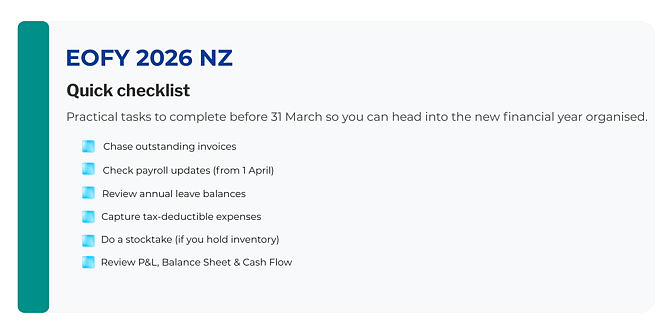
EOFY 2026 Quick Checklist
Use this EOFY checklist to work through the most important tasks before the end of the financial year.
💡 Work through the list below and tick off what applies to your business.
Important EOFY 2026 Dates in New Zealand
These are the key EOFY dates New Zealand business owners should have in their calendar.
💠 31 March 2026 - End of the financial year.
💠 7 July 2026 – Income Tax return deadline if you do not use a tax agent or accountant.
💠 28 August 2026 - Terminal Income tax due date for many taxpayers without a tax agent or accountant.
Payment dates for tax may vary depending on your filing and payment arrangements, so check your setup if you are unsure.
Prefer to work through the numbers properly?
Download the Tax & Leave Provisions Spreadsheet to track GST, Income Tax, PAYE and Annual Leave.
1. Chase Outstanding Invoices First
Before 31 March, make sure you have actually been paid for the work you have done.
💠 Turn on Xero reminders so you are not manually chasing payments.
💠 Send statements for overdue invoices.
💠 Key tip: Pick up the phone.
Email reminders are easy to ignore. A quick phone call usually gets things moving.
Start by asking if they have received the invoice.
“Just checking you received the invoice - sometimes they get buried in inboxes.”
If they haven’t seen it, confirm you are sending the invoice to the correct email address. Resend it while you are on the call and ask them to confirm it has arrived.
If they have received it but not paid, ask when you can expect payment. Cash flow removes a lot of stress. EOFY is the perfect time to tidy this up.
2. Review Cash Flow Health
Look at:
💠 Profit margins
💠 Debt levels
💠 Late paying customers – late payments are one of the most common causes of cash-flow pressure for small businesses.
💠 Ongoing pressure points
Cash flow is simply the money moving in and out of your business and keeping a close eye on it helps ensure you can cover expenses and plan ahead.
Even profitable businesses can struggle if cash isn’t coming in fast enough to cover expenses.
A strong cash-flow strategy helps keep your business running smoothly:
💰 Invoice quickly - don’t wait until month end.
💰 Offer early payment discounts to encourage faster payment.
💰 Make it easy for customers to pay - accept bank transfers, credit cards and online payment options like Stripe, GoCardless or PayPal.
💰 Follow up overdue invoices promptly.
💰 Negotiate better supplier terms to ease cash-flow pressure.
Small adjustments now can stabilise the year ahead.
3. Get Your Records Organised
EOFY is much easier when your systems are not chaotic.
💠 | Store documents digitally - not hiding in your email. |
Email documents directly to Xero > Files or Hubdoc so they are stored with your other financial records. Xero > Files is included in your Xero subscription and can store almost any file type, including BMP, CSV, DOC, DOCX, EML, GIF, JPEG, JPG, ODF, ODS, ODT, PDF, PNG, PPT, PPTX, RTF, TIF, TIFF, TXT, XLS, XLSX and ZIP. Each file must be under 25MB. | |
|
💠 | If you are doing your own bank reconciliations, record the basics: |
Who you paid - the contact name What it was for - choose the account from the list Why - a short description This helps you remember later and makes life much easier for your bookkeeper or accountant. | |
|
|
💠 | Reconcile your bank transactions weekly or monthly - not just at GST or tax time. |
|
|
Future you will thank you.
If understanding your numbers in Xero feels confusing, I run Financial Foundations & Insights 1 to 1 Xero Coaching sessions that walk you through it step-by-step.
4. NZ Payroll Changes from 1 April 2026
This is the part you do not want to ignore.
Payroll is usually one of the biggest expenses in a business, so getting it right affects your cash flow, budgets and financial reporting. When payroll sits cleanly inside your bookkeeping system, it becomes much easier to see your true labour costs and plan ahead.
Several payroll updates take effect from 1 April 2026. If your system is not updated before your first April pay run you risk compliance issues and frustrated staff.
Here is what is changing, from 1 April 2026:
💠 | Minimum Wage Increase 2026 NZ |
|
|
Adult minimum wage increases to $23.95 per hour. Starting out and training wage increases to $19.16 per hour. This applies to hours worked from 1 April onward, even if the pay date falls later. Most payroll systems update automatically, but you are still responsible for making sure the rates are correct. If you want a refresher on what employers should review when minimum wage increases, read our previous article: Minimum Wage Is Increasing on 1 April 2024. Are You Ready? | |
Key factors to consider include:
| |
💠 | KiwiSaver Contribution Increase 2026 |
|
|
| From 1 April 2026:
This will slightly increase employer costs and slightly reduce employee take-home pay. Most payroll systems update automatically, but you are still responsible for making sure the rates are correct. What to do:
|
💠 | Temporary KiwiSaver Rate Reductions |
|
|
| From 1 February 2026, employees can apply to Inland Revenue to temporarily stay at 3% instead of moving to the new 3.5% contribution rate. The temporary reduction can last three to twelve months. If approved, you will need to manually update their contribution rate in your payroll system. This change is not automatic. ‼️Employees must apply and provide confirmation of approval before the payroll rate is adjusted. You can read more or apply here:
❗Inland Revenue will issue a confirmation notice showing the start and end dates of the temporary rate reduction. Employees must provide this notice to their employer before payroll can apply the reduced rate. If no approval notice is provided, payroll must apply the default 3.5% KiwiSaver rate. 💡 Keep the approval notice or KS2 form with your payroll records so you know when the reduced rate expires.
|
💠 | Review Annual Leave |
|
|
Accrued annual leave is a liability. It represents money your business owes employees for leave they have earned but not yet taken. At EOFY: | |
|
|
✔️ Check leave balances are accurate | |
Confirm all leave taken has been recorded in payroll and that employee balances reflect the leave they have actually used. Accurate leave records are important because employers must keep correct records of leave taken, leave balances and payments made under NZ employment law. Things that often cause incorrect balances:
These small errors can quietly inflate or understate your annual leave liability. | |
|
|
✔️ Understand your Annual Leave liability | |
Your annual leave liability is the dollar value of all annual leave employees have accrued that would need to be paid if they left today. This amount sits on your balance sheet because it represents money the business owes employees for annual leave they have earned. Large annual leave balances can quietly build up over time and become a significant cost if several staff leave at once. | |
|
|
✔️ Encourage staff to take annual leave (where appropriate) | |
If your business is seasonal or impacted by winter weather, quieter periods are a good opportunity for staff to take annual leave and help prevent large annual leave balances building up. Unused annual leave can build up as a financial liability for businesses if employees accumulate large balances, especially if several staff leave and the business must pay out their unused annual leave. Planning annual leave during slower periods helps smooth staffing levels and keeps annual leave liabilities under control. Regularly reviewing annual leave balances helps prevent large annual leave liabilities building up and keeps payroll records accurate. Clean leave records protect your balance sheet from unexpected payouts. | |
|
|
💠 | ACC Earners Levy 2026 |
|
|
From 1 April 2026:
This means the levy is only charged on income up to that threshold. It will not massively change take-home pay, but your payroll system still needs to be updated before your first April pay run. Most payroll systems update automatically, but it is still worth checking the rate has updated correctly. | |
|
|
Quick Payroll Checklist Before 1 April 2026 | |
|---|---|
✅ | Confirm the minimum wage has updated in your payroll software |
✅ | Confirm the default KiwiSaver contribution has changed to 3.5% in your payroll software |
✅ | Check KiwiSaver settings for employees aged 16 and 17 |
✅ | Apply temporary KiwiSaver reductions where approved |
___ | ________________________________________________________________________________ |
If you are unsure whether your payroll system is updated correctly, EOFY is a good time to review it.
Payroll should sit cleanly inside your overall bookkeeping system. When payroll feels messy or confusing, it usually means the underlying systems need attention.
Related Payroll Blogs
If you want to go deeper into payroll and what it means for your business, my previous blogs are a good place to start:
5. KiwiSaver Top-Up for Business Owners
Unlike employees, KiwiSaver contributions are not automatic for self-employed people, so you need to make the contribution yourself before the deadline.
If you are self-employed, you can still take qualify for the KiwiSaver government contribution.
To receive the full contribution:
💠 Contribute at least $1,043 to your KiwiSaver before 30 June 2026.
💠 If eligible, you can receive a government contribution of up to $260.72.
EOFY is a good reminder to check whether you have contributed enough to receive the full amount.
This contribution is not automatic for self-employed people, so it is easy to miss if you are not keeping an eye on it.
6. Common End-of-Year Business Expense Deductions
Before EOFY, review your expenses to make sure you have captured all legitimate deductions. In New Zealand, expenses are generally deductible if they are incurred while earning business income and properly recorded.
Common deductions include:
Home office expenses - if you work from home, you may be able to claim a portion of power, internet, rates, mortgage interest or rent based on the percentage of your home used for business.
This is usually calculated using the floor area of the workspace compared with the total area of the home.Internet costs used for business purposes — where the service is used for both business and personal use, only the business-use portion can be claimed.
A 50% split is commonly used for home internet services if business and personal use are similar. If you have a separate internet or phone line used only for business, the full cost can usually be claimed.Vehicle costs (fuel, servicing, insurance, registration and depreciation) - claim the business-use portion if the vehicle is used for both business and personal travel.
Only the business-use portion is deductible, so costs must to be split between business and personal use. This is usually calculated using a logbook or kilometre method to determine the business-use percentage.
A 90-day logbook can be used to calculate the business-use percentage and is valid for up to three years if usage stays similar.Business expenses paid personally - include any legitimate business costs paid from your personal bank account or credit card. These should still be recorded in your business accounts so they are not missed at tax time.
💡 | Search your personal bank and credit card statements for business purchases. Many deductions are missed simply because they were not paid from the business account. | |
|---|---|---|
|
|
If an expense is partly personal and partly business, only the business portion can be claimed.
Keeping good records and receipts makes EOFY much easier and ensures you can claim everything you are entitled to.
Prepare for Tax Time
Many business owners only review expenses at year end, which can mean missed deductions or a rushed scramble for receipts.
Set aside funds early so tax does not surprise you. Unlike PAYE wages, tax is not automatically deducted for business owners, so planning ahead helps avoid large unexpected bills.
🔍 I originally built this spreadsheet for my bookkeeping clients so they could see upcoming tax and annual leave obligations before they became a problem.
💡To make this easier for all business owners, we created a Taxes & Leave Provisions Spreadsheet that helps track upcoming obligations such as GST, Income Tax, PAYE and Annual Leave.
It gives you visibility of what’s coming so you can set money aside and avoid unexpected cash-flow surprises.
👉 Download the Taxes & Leave Provisions Spreadsheet here or click the blue button below
7. Do a Stocktake (if you Hold Inventory)
1️⃣ Count it
2️⃣ Match it
3️⃣ Write off what is unsellable
A stocktake confirms the actual inventory you have on hand, which is needed for accurate financial reporting and tax calculations.
This is also a good chance to spot slow-moving stock that is tying up cash.
Stock that is damaged, obsolete or unsellable should be written down or written off before year end so your accounts reflect the real value of your inventory.
Your closing stock value directly affects your profit and tax calculation for the year, so it is important to get it right.
💠 Simple but important
8. Review the Reports that Matter
Don't just file them away and forget about them. Look at:
💠 Profit and Loss - see whether your business is actually profitable.
💠 Balance Sheet - understand what your business owns and owes.
💠 Cash Flow - track the money moving in and out of your business.
💠 Key Reports - use the tools in your accounting system to monitor performance.
EOFY is the perfect time to step back and see what the numbers are actually telling you.
If reading financial reports feels confusing, our Financial Foundations and Insights 1 to 1 Xero Coaching helps business owners understand their numbers and use them to make better decisions.
Price Increase 1 April 2026
The current investment is $750 per person (incl. GST)
From 1 April 2026, it increases to $900 per person (incl. GST)
If Xero training has been sitting on your “I should really do that” list, this is your moment.
👉 Lock in the current pricing before 1 April 2026 and secure your place now:
https://www.conduitbusinesssolutions.nz/xero-foundations-and-insights/
Four hours of focused Xero learning now can save you weeks of clean-up, stress and avoidable accounting fees later.
If you’re tired of half-trusting your numbers in Xero and want clarity instead of confusion, this is your next step.
Understanding your reports is one of the biggest shifts from running a business on gut feel to running it with real financial insight.
Know your numbers. Make decisions from clarity.
EOFY Bingo
To make this slightly less boring, we have included our EOFY Bingo card 🎯
Tick off what you have already done. See how close you are to a full house.
Sometimes business admin needs a little fun 😁
Let’s Keep EOFY 2026 Simple
Running a business is hard enough without scrambling at year end.
Get paid, clean up your records, check payroll updates, review your numbers and head into the new financial year organised.
A bit of preparation now - especially around the NZ payroll changes from 1 April 2026 - can save stress and awkward conversations later.
At Conduit Business Solutions, we focus on practical bookkeeping, clean systems and keeping things simple.
Sometimes a quick outside review is all it takes to spot the gaps.
If you would like one of the team to review your Xero setup or make sure your systems are ready for the new financial year 👉 book a discovery meeting with me
No jargon.
No drama.
Just clear support.
About the Author
Rachel Paterson is the Chief Chaos Breaker at Conduit - helping New Zealand business owners simplify their bookkeeping and financial systems. With more than 35 years of experience across media, training, insurance, telecommunications and small business operations, Rachel combines practical know-how with a straight-talking approach that business owners appreciate. As a Xero Certified Professional and Xero Gold Partner, she focuses on turning messy numbers into clear, useful information so clients can make confident decisions.
Today, Conduit Business Solutions supports trades, retail, e-commerce and service-based businesses across New Zealand with practical bookkeeping, payroll, software training and app advice. The team works with tools like Xero, Cin7 and Lightspeed to help businesses streamline their systems and stay on top of their finances. Conduit’s goal is simple: help business owners work smarter, stay compliant and stay in control of their numbers.