
If your business can't operate without you for a week, it may be too dependent on you.
Strong systems and documented processes reduce bottlenecks and owner stress.
Visibility over finances and workflows helps businesses keep moving when you're away.
The right tools support consistency, accountability, and efficiency.
The goal isn't to remove yourself from the business — it's to create more freedom.
Be Honest ...
Could You Actually Switch Off for a Week?
Imagine this.
It's Monday morning.
Your phone is turned off.
Your laptop stays closed.
You don't check emails.
You don't answer calls.
You don't approve invoices.
You don't solve problems.
You don't jump into the business "just for five minutes."
For one full week, you're unavailable.
What happens next?
Do things keep moving?
Or does everything stop until you come back?
For many business owners, even thinking about this feels uncomfortable.
Not because they don't want time off.
Because they don't believe they can take it.
As we move into the second half of the year, it's a good time to ask yourself an important question:
Could your business keep running if you stepped away for a week - and more importantly, could you actually enjoy the break?
If the answer is no, it's often a sign that the business has become too dependent on the owner.
The Hidden Cost of Being Indispensable
At first, being involved in everything feels responsible.
You know the clients.
You know the numbers.
You know how things work.
You know where everything is.
The problem is that over time, you become the answer to every question.
Need approval?
Ask you.
Need a supplier paid?
Ask you.
Need access to information?
Ask you.
Need a decision made?
Ask you.
Eventually, the business starts revolving around one person.
While that might feel productive, it's actually creating a bottleneck.
The consequences usually show up as:
Long hours
Constant interruptions
Delayed decisions
Frustration from team members
Difficulty growing
Burnout
If every decision has to go through you, you've built yourself a job — not a business.
A Lesson I Didn't Understand at the Time
This reminds me of something our accountant said to my late husband and me when we bought our first business over 27 years ago. It's one of those comments that didn't really sink in at the time, but I've thought about it often over the years.
He looked at us and said, "Congratulations... you've just bought yourselves a job."
I smiled at the time, thinking he just didn't understand our youthful enthusiasm. We loved what we did, so why wouldn't we want to own our jobs? Looking back, I realise he understood exactly what lay ahead. I was the one who didn't.
We'd both always had the security of a regular wage landing in the bank every payday. Owning a business felt like freedom. We weren't afraid of working hard - we expected 12 to 18-hour days and six or seven-day weeks when needed. That all seemed like a fair trade-off for being our own bosses, building something that was ours. We'd duck out early on a Friday to head to the beach for the weekend. We really thought we were living the dream.
What I didn't appreciate was that we'd also become responsible for everything. If we weren't there, things stopped. If we didn't make the decisions, they didn't get made.
Looking back now, I realise our accountant wasn't being negative. He was giving us one of the most valuable pieces of business advice we'd ever receive.
It just took me decades to fully understand it.
Along the way came a terminal illness diagnosis and the heartbreaking loss of my brother, my dad and my husband within just three years. Experiences like those have a way of putting everything into perspective.
They taught me that while businesses are important, they can never be more important than the people we love. If your business can't function without you for a few days or a few weeks when life demands your attention, the business is running you - not the other way around.
That's why I'm so passionate about helping business owners build systems that create genuine freedom. Not so you can work less, but so you have the freedom to be where you're needed most when life throws a spanner in the works.
The Week-Off Test
One of the simplest ways to identify weaknesses in your business is to ask:
What would happen if I disappeared for a week?
Not forever.
Just one week.
Think through some common situations.
A Supplier Invoice Arrives
Can it be processed?
Can it be approved?
Can it be paid?
Or does it sit there waiting for you?
Payroll Needs to Be Processed
Where are the hours recorded?
Who checks them?
Who processes payroll?
Who authorises the payments?
What happens if you're unavailable?
A Customer Has a Question
Can your team find the answer?
Or is the information stored inside your head?
GST Is Due
Can the process continue?
Or does everything pause until you return?
These aren't hypothetical questions.
They're a practical way to test whether your business is supported by systems - or by you.
Life Doesn't Wait for Good Timing
Life has also reinforced this lesson in ways I never expected.
One client genuinely believed she'd be able to approve payroll payments from her hospital bed after undergoing brain surgery. It seemed like a reasonable plan at the time.
The reality was very different.
The medication left her unable to think clearly enough to even log in to her online banking, let alone create and authorise a handful of individual payroll payments. Thankfully, her partner was able to step in so the team still got paid on time. But it was a timely reminder that no business should rely on one person always being available.
It's a situation none of us plans for, but it happens more often than we'd like to think.
Illness. Accidents. Family emergencies. Loss.
The true fire engine moments - when everything else stops because something more important demands your attention.
Life doesn't wait until it's convenient.
I've seen that in my own life, and I've seen it with clients too.
If you're the only person who can approve payments, process payroll, access key information or make decisions, your business is only one unexpected event away from grinding to a halt.
Building systems isn't about preparing for the worst because you're pessimistic. It's about protecting your business, your team and your family if life suddenly changes course.
Because sometimes the biggest risk to your business isn't the obvious one — like an economic slowdown, recession or losing a customer.
It's assuming you'll always be available tomorrow.
The Signs Your Systems Are Working
The good news is that building a business that can operate without you doesn't require a complete overhaul.
It usually starts with a few simple foundations.
You Have Visibility Over Your Numbers
You know:
What money is coming in
What bills need paying
What your cashflow looks like
What requires attention
Without digging through emails or spreadsheets.
Information Is Easy to Find
Documents aren't buried in inboxes.
Receipts aren't sitting in drawers.
Important information isn't stored on one person's laptop.
Everything has a home.
People Know What to Do
Your team doesn't need to ask you every question.
Processes are documented.
Responsibilities are clear.
Work keeps moving.
Tasks Happen Consistently
Bills are processed.
Customers are looked after.
Payroll gets completed.
Reconciliations happen.
Not because someone remembered.
Because the system supports it.
What This Looks Like in Real Life
Let's make this practical.
Supplier Invoices
Without a process:
❌ Invoice arrives
❌ It sits in an inbox
❌ Nobody knows whether it's been approved
❌ Payment gets delayed
❌ Supplier puts you on credit hold
❌ Future orders can’t be processed until payment is received
With a process:
✅ Invoice arrives
✅ Captured digitally
✅ Approved through a workflow
✅ Sent for payment
✅ Stored and reconciled
The owner doesn't need to touch every step.
The system does the heavy lifting.
Payroll
Without systems, payroll can become stressful every pay cycle.
With systems:
✅ Timesheets are submitted
✅ Hours are checked
✅ Payroll is processed
✅ Employees get paid
Simple.
Consistent.
Predictable.
Customer Enquiries
When information is documented and easy to access, your team can answer questions without waiting for you.
Customers get faster responses.
Your team feels empowered.
And you get fewer interruptions.
Everybody wins.
The Systems That Create Freedom
The goal isn't to use every app available.
The goal is to create a workflow that works for your business.
For many businesses, that includes tools that provide:
Better visibility over finances
Digital document storage
Automated data capture
Approval workflows
Industry-specific operational support
The right technology can reduce manual work and improve consistency, but technology alone isn't the answer.
The real value comes from having clear processes and ensuring everyone knows how those processes work.
The objective stays the same:
👉 Less reliance on people.
👉 More reliance on systems.
How We Help at Conduit
At Conduit, we don't just focus on bookkeeping.
We focus on how information flows through your business.
We help clients:
Build practical systems
Streamline processes
Improve visibility
Reduce bottlenecks
Create confidence in their numbers
Because good systems don't just make bookkeeping easier.
They make running the business easier.
And often, they give business owners something they've been missing for a long time:
Freedom.
The Core Message
If taking a week off feels impossible, that's valuable information.
It's showing you where the business relies too heavily on you.
And once you know where the gaps are, you can start fixing them.
What This Really Comes Down To
A week off isn't actually the goal.
Freedom is.
Freedom to step away.
Freedom to spend time with family.
Freedom to take a holiday without checking emails every hour.
Freedom to know the business can keep running without you.
And I know this from experience.
After nearly nine years in business, I'm putting the finishing touches on this blog from an airport lounge, about to head off on my second proper break in six months.
The first was over Christmas and New Year. For the first time ever, we closed the office for 10 days.
And guess what?
No one missed getting paid.
No invoices were forgotten.
Maybe a few payment reminders went out a little earlier than planned—but honestly, that's Christmas. By Boxing Day most of us have forgotten what day of the week it is anyway.
This holiday is a little different. I'm heading overseas, so switching off matters even more because of the time difference. Even more importantly, I'm travelling with my bestie—someone who's been there through plenty of business highs, lows and everything in between.
That time together matters.
Just like time with your partner, your kids, your whānau or the people who matter most in your life.
It's only 14 days away – just 10 business days - but getting to the point where I could genuinely step away didn't happen overnight. It took months of planning, documenting processes, handing work over, preparing the team and, probably hardest of all, trusting them to do what they do best.
And that's exactly the point.
Businesses don't become resilient by accident.
They become resilient because their owners deliberately build systems, document processes and create a team that isn't dependent on one person having all the answers.
That's what good systems create.
Not just smoother bookkeeping.
Not just better processes.
Freedom.
Where To From Here?
If the idea of taking a week off makes you nervous, you're not alone.
Most business owners start there.
But it doesn't have to stay that way.
The businesses that operate smoothly without the owner aren't lucky.
They've simply invested time into building systems that support them.
And those systems can be built.
Need a Hand?
If you'd like one of the team to review your systems, identify bottlenecks, or help create processes that keep your business running smoothly when you're away, get in touch with Rachel and the team at Conduit Business Solutions.
Simple systems. Clear processes. More freedom.
✍️About the Author
Rachel Paterson is the Chief Chaos Breaker at Conduit Business Solutions, helping New Zealand business owners simplify their bookkeeping, financial systems and day-to-day processes.
With more than 35 years of experience across media, training, insurance, telecommunications and small business operations, Rachel combines practical know-how with a friendly, straight-talking approach. As a Xero Certified Professional and Xero Platinum Partner, she focuses on turning messy numbers and disconnected systems into clear, useful information business owners can act on.
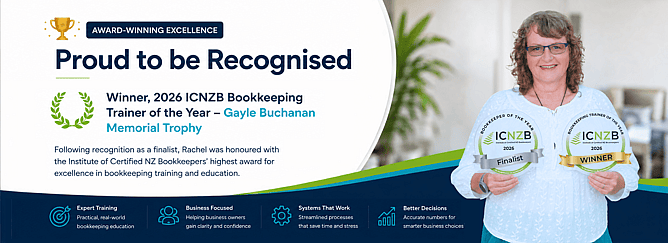
In 2026, Rachel was named a finalist in two ICNZB Excellence Award categories and went on to win Bookkeeping Trainer of the Year, recognising her commitment to practical, accessible training for New Zealand businesses.
Conduit supports trades, retail, e-commerce and service-based businesses across New Zealand with bookkeeping, payroll, Xero training, reporting and app advice. The goal is simple: help business owners feel clearer, more confident and more in control.